
 Get In Touch
 (423) 355-1091
After a storm, the biggest question is usually not “Do I need a new roof?” It is “What am I supposed to do next?” That is why the best first step is often a professional roof inspection. Storm damage is not always obvious from the ground, and some of the most important warning signs can be easy to miss at first. Before you call your insurance carrier, it helps to understand what condition your roof is actually in, what signs matter, and what the next step should be.
If you are searching for storm damage roofing repair, roof inspection Chattanooga TN, hail damage roof inspection near me, roof leak after storm Chattanooga, or what to do after a storm damages your roof, start with clear answers. Call CH Roofing to schedule a free roof inspection.
After the Storm, Uncertainty Is Usually the Hardest Part
When a storm moves through, most homeowners are not thinking in roofing terms. They are thinking about their home, their family, and whether everything is still protected. They are listening for drips, checking the ceiling, looking at the yard, and wondering whether the weather that just passed through caused actual damage or just left behind a lot of stress.
That uncertainty is what makes storm damage so difficult. Sometimes the signs are obvious. A limb has landed on the roof. Shingles are in the yard. Water is already showing up inside. But a lot of the time, the house looks mostly normal from the driveway, and that is where the real questions begin.
You may find yourself wondering whether hail damaged the roof even though you do not see a leak. You may notice debris in the yard, but no major change from the street. You may be asking yourself whether you should call insurance right away or whether it makes more sense to have the roof checked first. Those are common questions, and they are reasonable ones.
A lot of homeowners feel pressure in this moment to act fast without really understanding what happened. But a rushed decision is not usually the most helpful one. A better response is a clear one. Before anything else, it helps to understand whether there are signs of storm damage, what those signs may mean, and how to move forward without making the situation more stressful than it already is.
Why Roof Storm Damage Is So Easy to Miss
One of the biggest misconceptions homeowners have is that storm damage should be obvious. Sometimes it is. But many roofing issues begin in subtle ways that are hard to spot from the ground.
High winds can lift shingles without tearing them off completely. Hail can bruise roofing materials, loosen granules, and dent flashing or vents without causing immediate water intrusion. Heavy rain can expose weak points around valleys, skylights, pipe boots, flashing details, or roof transitions that were already vulnerable. A roof can absolutely be affected even when it still looks mostly intact from the street.
That is why searches like how do I know if my roof has storm damage, how to tell if your roof has hail damage, and can a roof be damaged without leaking are so common. Most homeowners are not trying to diagnose the whole roof. They are trying to understand whether their concern is worth taking seriously.
Some of the most common signs worth noticing after a storm include:
- missing shingles or ridge cap pieces
- lifted or creased shingles
- dents on gutters, downspouts, flashing, or vents
- granules collecting near downspouts or in gutters
- fallen limbs or debris impact near the roofline
- ceiling stains or upper-wall discoloration
- damp insulation or musty attic smells
- moisture around chimneys, vents, or skylights
Not every sign points to major damage, but every sign adds context. And context matters. A roof does not need to be visibly failing to deserve attention. In many cases, the most helpful thing a homeowner can do is recognize that “nothing dramatic” and “nothing wrong” are not always the same thing.
What Chattanooga Homeowners Should Do First After a Storm
If you are searching for what to do after a storm damages my roof, the answer should feel practical, not overwhelming.
Start with safety. Stay off the roof. Wet surfaces, hidden damage, and unstable areas are not worth the risk. Begin at ground level and walk around the property slowly. Look at the roofline, gutters, downspouts, soffits, fascia, siding, and anywhere branches or debris may have landed. Then head indoors and check ceilings, attic spaces, upper walls, and corners where water intrusion may show up first.
If you notice anything unusual, take photos. You do not need a perfect damage report. You just need a basic record of what caught your attention while it is still fresh.
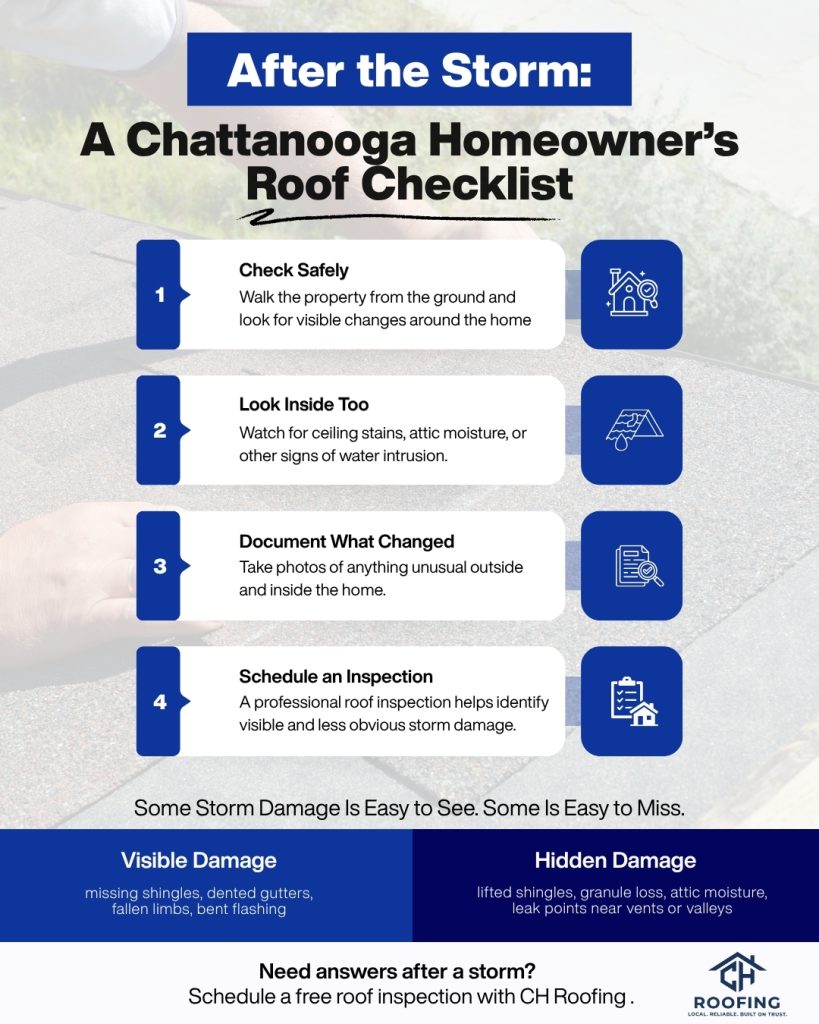
A calm post-storm response usually looks like this:
- Inspect from the ground, not from the roof
- Check exterior areas around the home for visible changes
- Look indoors for stains, damp spots, or attic moisture
- photograph anything that seems unusual
- Schedule a professional roof inspection
- Review the findings before deciding the next step
That sequence matters because it helps homeowners avoid both extremes. It keeps people from panicking too quickly, but it also keeps them from waiting too long just because the roof does not look dramatic from the driveway.
Why a Roof Inspection Often Makes Sense Before Calling Insurance
This is where many homeowners feel stuck. They know something may be wrong, but they do not know whether the first call should be to insurance or to a roofing professional.
In many cases, a professional roof inspection provides a clearer starting point. That is not about delaying the roofing insurance process. It is about understanding the condition of the roof before trying to explain a problem you cannot fully see.
Without an inspection, homeowners are often working from uncertainty. They may know there was hail, wind, or heavy rain. They may suspect roof damage. But they may not know whether the issue is visible, where it appears, or how serious it seems. That lack of clarity can make the whole process feel bigger and more confusing than it needs to be.
A professional inspection helps create a better foundation for the next step. It can help clarify:
- whether visible storm-related damage appears to be present
- Which parts of the roof system may be affected
- whether the damage looks isolated or more widespread
- whether there are signs of hidden moisture intrusion
- What the homeowner should understand before contacting insurance
That is why homeowners often search, “Should I get my roof inspected before filing an insurance claim, or ” Who should I call first after storm damage to my roof. What they are really asking is how to make the smartest first move. In many cases, the calmest path is to understand the roof first.
What a Professional Roof Inspection Actually Helps You Understand
A strong inspection does more than answer yes or no. It helps define the situation in a way that homeowners can actually use.
Most people think of the roof as the shingles they can see from the ground. But the roofing system includes much more than that. Flashing, valleys, ridge lines, pipe boots, roof penetrations, drainage points, seal areas, and transitions all play a role in protecting the home. Storms do not just affect the most visible surfaces. They can also affect the smaller, more vulnerable parts of the system that homeowners are least likely to identify on their own.
That is why a roof inspection after a storm is so valuable. It helps answer the questions homeowners are really asking:
- Did the storm actually damage the roof?
- Are the signs minor, or do they point to something more serious?
- Are there weak points that could lead to future leaks?
- Does what I noticed inside the home connect to something happening on the roof?
- What should I do next, now that I know more?
A good inspection also helps reduce hesitation. It gives homeowners a clearer picture of what happened and replaces guesswork with information. That does not mean every inspection leads to a large repair decision. Sometimes clarity means confirming that the concern is limited. Sometimes it means catching an issue early. Either way, information is what makes the next step more manageable.
What Wind, Hail, and Heavy Rain Can Each Do to a Roof
Not every storm affects a roof in the same way. That is one reason post-storm roofing concerns can feel confusing. Different weather events create different damage patterns, and sometimes more than one type of damage is present at the same time.
Wind damage often affects shingles, ridge caps, and seal lines. Strong gusts can lift edges, loosen tabs, create creases, or break the seal that helps shingles stay in place. A roof may still look mostly intact from the ground and still have areas that are more vulnerable than they were before the storm.
Hail damage is often harder for homeowners to identify confidently on their own. Hail can bruise asphalt shingles, knock off protective granules, dent metal components, and affect vents, flashing, gutters, or other exposed surfaces. A hail-damaged roof does not always leak immediately, but that does not mean the roofing material came through unharmed.
Heavy rain tends to expose weaknesses. It may reveal problems around flashing, valleys, penetrations, skylights, or drainage areas. In some cases, the storm did not create the vulnerability from scratch, but it was the event that made the vulnerability visible.
This is why many homeowners search for hail damage roof Chattanooga, wind damage roof repair Chattanooga, or roof leak after heavy rain Chattanooga. The goal is not just to name the weather event. It is to understand how that weather may have affected the roof and whether the signs deserve professional attention.
Why Homeowners Often Wait Too Long to Get the Roof Checked
A lot of homeowners do not delay because they are careless. They delay because they are trying to be reasonable.
They do not want to overreact. They do not want to assume the worst. They may tell themselves they will keep an eye on it for a few days. They may think that if there is no active leak, the roof is probably fine. That instinct makes sense, but it can also work against them.
A roof does not have to be leaking today to have a real storm-related problem. A lifted shingle, compromised flashing detail, or weakened penetration point may not create symptoms indoors right away. But those weaker areas can become the places where the next hard rain or the next storm starts causing more visible trouble.
That is part of why signs of roof damage after hail and roof leaks after storms in Chattanooga are such common searches. Homeowners are often trying to figure out whether the problem started days ago, even though the signs are only becoming obvious now.
A prompt inspection helps preserve clarity. It gives the homeowner a better chance to connect what they are seeing to the storm that likely caused it, and it helps reduce the uncertainty that comes with waiting and wondering.
Common Mistakes Homeowners Make After Storm Damage
Post-storm mistakes are usually not about carelessness. They are about uncertainty. Homeowners are trying to make the best decisions they can with limited information, which is exactly why clear educational content matters.
Some of the most common mistakes include:
- Assuming the roof is fine because there is no active leak
- focusing only on missing shingles and overlooking flashing, vents, or valleys
- checking only the outside of the home and not the attic or upper rooms
- skipping photo documentation when the first signs appear
- Waiting too long because the roof looks mostly normal from the ground
- comparing their home to a neighbor’s roof after the same storm
- feeling pressured to make decisions before the roof has been properly evaluated
Every roof responds differently to weather. Age, slope, material, prior wear, ventilation, and surrounding trees all influence how storm damage shows up. Two homes on the same street can come through the same weather event with very different roofing concerns. That is why a thoughtful inspection matters more than assumptions.
Why the Insurance Side Feels So Stressful
Most homeowners do not deal with storm-related roof concerns often, so it makes sense that the insurance side of the process can feel intimidating. They are trying to protect their home, understand what happened, and make the right decision without feeling rushed or overwhelmed.
This is where communication becomes just as important as roofing knowledge.
When homeowners understand what the roof inspection found, the next step becomes easier. They are no longer working only from suspicion or general concern. They have a better sense of what signs are present, what areas may be affected, and what the situation appears to be. That does not guarantee any specific outcome, but it does make the process feel more grounded.
For voice-search users asking should I call insurance or a roofer first after a storm, the practical answer is often that a roof inspection makes the insurance conversation easier to understand. It is much harder to feel confident about your next move when you do not yet know what happened to the roof.
Why Local Context Matters So Much in Chattanooga
Storm damage roofing is always local, and that matters in the Chattanooga area.
Weather patterns here can bring strong winds, hail, heavy rain, and fast-moving storm systems that affect neighborhoods differently. One part of town may see more hail. Another may get harder wind exposure. Another may deal with intense rainfall that reveals weaknesses around drainage or flashing. Even homes in the same neighborhood can respond differently depending on roof age, material condition, slope, ventilation, and previous wear.
That local variability is why searches like roof inspection Chattanooga, TN, storm damage roofing Chattanooga, hail damage roof inspection Chattanooga, roof repair after storm Chattanooga, and local roofers near me after hail storm matter so much. Homeowners are not just looking for someone who works on roofs. They are looking for someone who understands local conditions and can explain what those conditions may have done to their home.
Local knowledge also helps build trust. Homeowners want to feel like the person evaluating the roof understands the kind of weather the area gets and the kind of storm-related issues that commonly follow. That kind of familiarity makes the guidance feel more grounded and more useful.
How Trust Is Built in Moments Like This
When homeowners are dealing with possible storm damage, they are not usually looking for the loudest company. They are looking for the one who feels dependable.
They want communication that feels calm. They want explanations that make sense. They want a local roofing company that seems honest, knowledgeable, and easy to talk to. They want to feel like they are calling people who will help them understand what is happening instead of making the situation feel bigger than it already does.
That is why this kind of blog matters. It is not just answering search questions. It is shaping how a homeowner feels about whom they may call next. Educational content builds trust when it sounds clear without being cold, informed without being overwhelming, and reassuring without sounding vague.
That is often what homeowners remember most. Not just what a company says it does, but how it makes them feel in a stressful moment.
How CH Roofing Helps Homeowners Move Forward with Clarity
After a storm, most people do not want a complicated pitch. They want answers.
They want to know whether the roof shows signs of storm damage. They want to know what those signs may mean. They want to know whether the situation looks minor or whether it deserves more attention. And they want to know they can talk to someone who will walk them through the next step clearly.
That is where CH Roofing is best positioned. Clear inspections, honest communication, and steady guidance help homeowners move from uncertainty to understanding. The value is not only in identifying visible roofing concerns. It is also in helping people feel less overwhelmed by the process.
In a trust-heavy industry like residential roofing, that matters. Homeowners remember who made the situation easier to understand. They remember who communicated clearly. They remember who treated them like a person instead of a job number.
Final Thoughts
A storm can leave behind more than physical damage. It can leave a homeowner with a lot of uncertainty.
Questions about the roof, questions about next steps, questions about whether insurance needs to be involved, and questions about who to trust all tend to show up at once. That is why the smartest first step is usually not to rush. It is to get clear answers.
A professional roof inspection helps homeowners understand whether the roof shows signs of hail damage, wind damage, or water-related vulnerability before they move into a bigger process. It helps them document what is visible, identify what may be hidden, and make the next decision with more confidence.
If your home has recently been through hail, high wind, or heavy rain, call CH Roofing at 423-355-1091 to schedule a free roof inspection. Get honest roofing guidance from a family-owned team proudly serving Chattanooga and surrounding communities.


